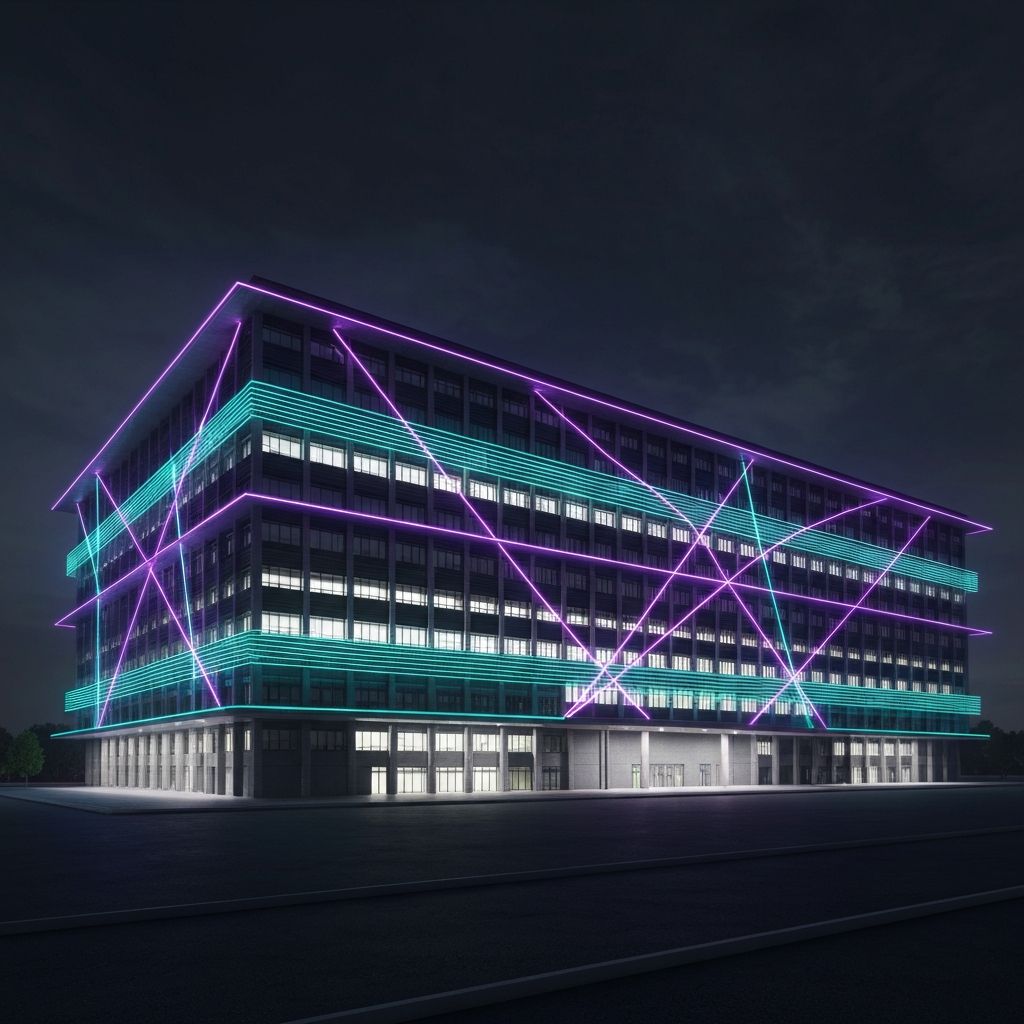
Ministry of Justice / Kier Group
HMP Millsike
Establishing good-order operation, trusted baselining and AI-ready building intelligence at a major UK custodial estate.
Lead Contractor
Kier Group
Environment
UK Custodial Estate
Primary Focus
Baselining & Readiness
Systems Reviewed
11 Systems
Future Decisions supported a Ministry of Justice / Kier Group project at HMP Millsike, with Kier Group acting as lead contractor. The work focused on bringing the building into good operational order by improving visibility across key building systems, validating data quality, reviewing metering, integrating BMS data and establishing the foundations required for a reliable operational baseline.
Project Context
HMP Millsike is part of the UK custodial estate and represents the type of complex environment where building performance, resilience, safety, comfort, compliance and operational readiness all matter.
Future Decisions worked within the wider Ministry of Justice / Kier Group delivery environment, supporting the creation of a reliable digital foundation for House Block C.
The project reviewed key building systems including:
- BMS connectivity
- Metering and submetering
- Lighting
- Water and domestic hot water
- Low temperature hot water
- Underfloor heating
- Ventilation
- CO₂, temperature and humidity sensing
- Comfort and air-quality monitoring
- Automated reporting capability
The objective was to establish whether the building systems and data were ready to support long-term baselining, future optimisation and evidence-led investment decisions.
The Challenge
Complex buildings often appear complete at handover, but their operational data can still be inconsistent, fragmented or difficult to trust. A BMS may show thousands of points, meters may not be clearly mapped, units may be inconsistent, documentation may not match installed assets, and systems may still be operating in test, commissioning or early-use modes.
Without trusted operational data, it is difficult to know:
- Whether the building is operating correctly
- Whether meters and submeters are reliable
- Whether heating and ventilation systems are performing as expected
- Whether comfort and air-quality standards are being achieved
- Whether plant is correctly configured
- Whether documentation matches the real building
- Whether future capital expenditure is justified
- Whether energy-saving measures will actually work
Future Decisions' role was to help turn early operational data into a structured, validated baseline that could support confident decision-making.
Future Decisions' Role
Future Decisions provided the digital building, data analysis and operational intelligence layer for the project. Using the Future Decisions Digital Building Platform, data from the building was collected, organised and reviewed to assess operational readiness and data quality.
Our work included:
The output gave the project team a clearer understanding of what was working, what needed attention and what data could be trusted.
Establishing Good-Order Operation
The primary purpose of the Millsike work was to help establish the building in good operational order. This means making sure the building is not only built and commissioned, but genuinely ready to operate, monitor and report over time.
Future Decisions reviewed whether key systems could provide usable data, whether sensors and meters were available, whether the BMS points could be understood, and whether the building was capable of supporting a reliable performance baseline.
A building cannot be improved intelligently until it is first understood properly.
Creating a Reliable Baseline
A reliable baseline is essential for future decision-making. Future Decisions' approach is to establish how the building performs over time, across changing weather, changing occupancy and changing operational conditions.
Supporting Future Capex Decisions
One of the most important outcomes of baselining is better capital expenditure decision-making. Without reliable operational evidence, capex decisions can be based on assumptions, complaints, incomplete data or supplier opinion.
By establishing a trusted operational baseline, Future Decisions helps clients make better decisions about:
- Whether plant is correctly sized
- Whether systems need replacement or adjustment
- Whether controls need improvement
- Whether additional sensors are required
- Whether metering needs correction
- Whether comfort issues are caused by controls, plant, operation or building fabric
- Whether proposed investments are likely to deliver value
- Whether AI augmentation is technically justified
This gives estate teams, contractors and clients a stronger evidence base before committing significant spend.
Secure BMS Connectivity
A core part of the work was establishing secure connectivity between the building systems and the Future Decisions platform. The project used controlled cloud connectivity, with the building network separated from the internet-facing side using a Niagara JACE architecture — featuring an enterprise-grade firewall, separate Ethernet ports to prevent IP crossover, and encrypted communication.
This approach supports:
- Secure data exchange
- Controlled BMS access
- Network separation
- Read-only operation where appropriate
- Encrypted communications
- Future controlled augmentation if required
- Improved data integrity
This is particularly important in public sector and custodial environments, where operational security and system separation are critical.
Metering and Data Validation
Metering was a major part of the Millsike work. Future Decisions reviewed the metering structure to understand whether energy and water data could be trusted and used for future reporting. This included reviewing meter hierarchies, BMS points, documentation, units, data quality and parent-child relationships between meters and submeters.
Future Decisions identified the importance of:
- Trusted meter trees
- Correct units
- Mapped BMS points
- Clear as-built documentation
- Validation against physical meters
- Ongoing checks during defects periods
- Alignment between schematics and live data
Lighting Operational Readiness
Future Decisions reviewed the lighting system to understand control behaviour, fault reporting capability and data visibility. The focus was not simply energy saving — the main objective was to understand whether the lighting system could support good operation, automated reporting and future optimisation.
The review considered:
- Lighting runtime
- Control strategy
- Emergency lighting status
- Lamp fault reporting
- Opportunities for automated maintenance alerts
- Opportunities for automated emergency lighting reporting
- Future improvements to occupancy-led control
Water and Domestic Hot Water
Future Decisions reviewed water and domestic hot water systems to understand data availability, operational behaviour and future monitoring capability.
Good water and hot water data is particularly valuable because demand changes significantly once buildings become fully occupied. The work helped assess whether water data could support future understanding of occupant demand patterns, hot water use, metering consistency, leak detection and system performance.
Underfloor Heating, LTHW and Comfort Readiness
Future Decisions reviewed underfloor heating operation, temperature strategy, thermal comfort monitoring, and the low temperature hot water system and its relationship with heating and ventilation.
Building issues are often connected across systems. A comfort issue may not be caused by the room controller alone — it may be linked to plant operation, heating distribution, pump behaviour, control logic or wider system configuration. Future Decisions helps reveal these connections by joining system data together.
Ventilation and Air-Quality Baselining
Ventilation was reviewed using CO₂, temperature and humidity data. The focus was to establish whether the building had the monitoring capability needed to assess ventilation performance.
CO₂ monitoring is particularly important because it helps show whether ventilation is aligned with actual use. Occupancy and seasonal variation strongly affect building performance and reliable baselining must account for both.
Future Decisions' ventilation analysis supports future understanding of:
- Air quality
- Over-ventilation and under-ventilation
- Humidity risk
- Comfort
- Demand-led control potential
- Future operational standards
AI-Ready Building Preparation
The Millsike project helped establish the conditions required for AI-ready operation. AI cannot deliver reliable optimisation without good data. Before AI control can be trusted, the building needs validated meters, reliable environmental sensors, clear system mapping, trusted data flows, understood occupancy patterns, stable operating conditions, controllable plant, secure connectivity and a reliable baseline.
Value Delivered
The HMP Millsike project demonstrates how Future Decisions helps complex buildings move from handover toward confident operation. The work created value by:
Case Study Summary
Project
Ministry of Justice / Kier Group — HMP Millsike
Lead Contractor
Kier Group
Environment
Major UK custodial estate
Future Decisions Role
Digital twin enablement, BMS integration, sensor uplift, metering validation, operational analysis and baseline preparation
Systems Reviewed
BMS, metering, lighting, ventilation, heating, domestic hot water, water systems and environmental sensors
Primary Focus
Good-order operation, data quality, baseline creation and future capex decision support
Key Outcomes
Improved system visibility, validated data foundation, operational readiness review, automated reporting, early fault detection and AI-ready building preparation
Platform
Future Decisions Digital Building Platform